
Last Updated on May 16, 2025 by Clark Omholt
Our experience of color is a fascinating mix of physics, physiology, and psychology.
In the following article, I’ll go through the three aspects and detail how humans perceive color. Towards the end, I’ll also talk a bit about how many colors humans can actually see, how many colors screens can produce, and whether you can actually spot the differences.
How Do Your Eyes See Color? Brief Overview of Human Color Perception
1. Physics | How does light affect color?
First, physics. An object doesn’t have an inherent color. Instead, the color we experience is a “color event,” which mixes the surface characteristics of the object, the light under which it is being viewed, and the eyes and brain of the person doing the viewing.
Take the example of a tan wall in your living room. When we experience this color, its surface is absorbing most of the wavelength in the blue and green parts of the spectrum and is reflecting back the wavelengths in the yellow and brown parts of the spectrum (570-600nm).
If the wall was bright white, it would be reflecting back most of the light in equal amounts across the spectrum. And if the wall was a deep black, it would be absorbing almost all the light, reflecting back very little. Thus, the tree leaf which turns black at night is nothing more than the absence of light.
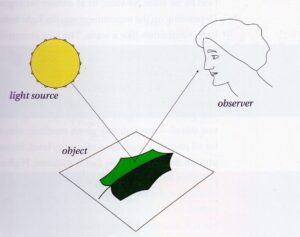
Now let’s view that same wall at noon and then at sunset. Are we experiencing the same color? Probably not. The light at noon is a mixture of bright sunlight (5000K) mixed with the sky’s blue – resulting in a quality of light known at D65 with a white point of 6500K. At sunset the light has to travel through more of the earth’s atmosphere causing the shorter wavelength blue light to get scattered, resulting in a more yellowish/reddish light. So, this tan wall will show a different color at noon at noon than at sunset.

2. Physiology | What parts of the eye detect color?
The key components of the human visual system that allow us to interpret color are the Rods and Cones found inside our eyes. The human eye has approximately 6 million photoreceptors known as Cones, and these correlate to the Red, Green, and Blue wavelengths. Photos come through the eye, hit the retina in the back of the eye, and simulate your various RGB Cones. How much of the components RGB a particular object reflects (or emits, in the case of an electronic screen like a TV) determines what color we are seeing.
The Rods, on the other hand, are optimized to help us perceive objects in low lighting. Most of the information captured by the Rods are about brightness. So when you are seeing a tree silhouetted at disk, and the green leaves are mostly dark gray, this is an example of the Rods kicking, attempting to provide detail in dim lighting. The Cones take a back seat, and color information is sacrificed.
Before we finish up with physiology, we need to give some credit to the brain. The eye, and the Rods and Cones, do a great job of generating color signals. But they count on the brain to interpret the signal into something you are able to make sense of.
3. Psychology | How does our brain perceive color?
The psychology of human color perception is a fascinating topic that has spawned many scholarly articles and PhDs. For the purposes of this article, I just want to make you aware of a few phenomena that affect how we perceive color.
1. Color Constancy
This has to do with how the brain’s perception of color stays consistent even when the source of illumination changes. For instance, if a lemon is illuminated by a red light, we might be seeing something orange-ish. But we know it’s a lemon, so our mind still sees it as yellow.
2. Simultaneous Contrast
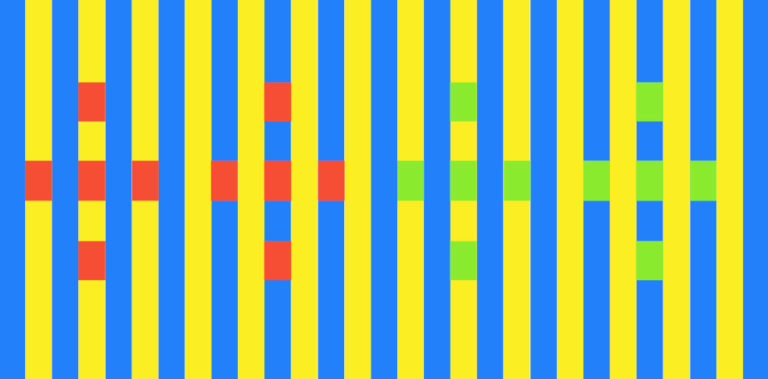
This describes the effect of surrounding colors on your perception. In the image below, all greens and reds are the same color. Practically, this means you may not want your desktop filled with a picture of your child holding a red balloon, as that might impact how your perceive your work.
Human Color vs Digital Color | How Many Colors Can Humans See?
It is estimated that humans can distinguish between about 1 million colors.
How does this compare to colors you are seeing on your monitor or your digital printer? Most digital screens work in RGB 8-bit color, which in theory can produce ~16 million colors. But the reality is that a typical sRGB screen can only achieve less than 40% of the colors viewable by humans. And printers have an even smaller color gamut.
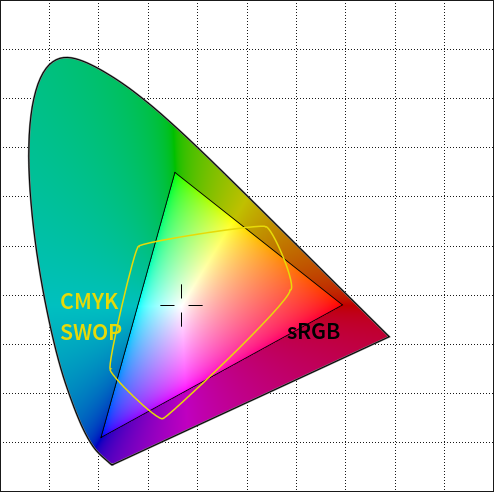
So digital systems have a lot of precision, but not so much gamut. A digital system can send two different signals to your screen – RGB 234, 200, 200 and 235, 200, 200 – but our eyes probably cannot see the difference.
If your focus is on color screen accuracy, however, then you will also want to calibrate your screen. This is where our product, the TruHu monitor calibration app, can help out. Give a try for free.



When will it be released for Android? It’s 2025, but why hasn’t even a beta version been released yet?
Android development is under way, though it is moving slower than we would prefer. Please tell us what model Android phone you have and your computer’s operating system. Also, let us know if you’d like to be part of the beta.